Leif Rydell
Southern Australia + Tasmania
Southern Australia + Tasmania.
Since I have been to Australia several times before but not to the southern part, this was a trip high up on my wishing list. My friend Nick from UK and I usually make one trip per year birding and this time we decided to go there. He has been there back 9in time but not for birding. I planned the itinerary to start and end in Adelaide. We started by visiting Kangaroo Island which is a stunning place in many ways. After that we had arranged with local birder Roly from Adelaide to do an Outback tour on the iconic Birdsville track. However, heavy rain earlier in the season made the whole trip impossible and we could only go as far as Etadunna. This meant several of the best birds were not possible. Still a very memorable trip. After this we then started our 10 day round tour from Adelaide in land vis Mildura, Hattah K N.P., Deniliquin, Melbourne and back to Adelaide on the Great Ocean Highway. Our last 5 days we flew in to Tasmania and stayed 4 nights on Bruny Island where you can see all the endemics.
The first pictures here show one of my target birds, the Hooded Plover which I missed in SW Australia many years ago and now spotted on the beach right at the harbour where the ferry arrives as a flock of Lesser Crested Terns. Shorebirds are just my favorite group, so diverse in habitat and appearance. Kangaroo Island is a place a have been reading about for along time and now had the privilege to visit. Many great birds and vistas.

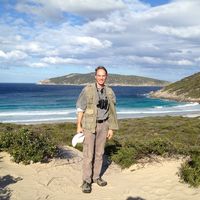
We drove further west on the island and spotted a special Goose, the Cape-barren Goose which breeds in smaller colonies with a few pairs as well as many stunning beaches (Nick by our car).


As the name of the island recalls, there are quite a few kangaroos and wallabies here. This cute Tammar wallaby showed well with a curious look half hidden ehind the bush and a few Silvereyes there as well. One of the most stunning birds and also very common is the Superb Fairy-wren.


Our last stop was at a seal rockery where saw both Au. Sea Lions and A. Fur Seals (and the common Silver Gull). By the center also a flock of Purple-crowned Lorikeets and a few Brown Thornbills.
We had to reschedule as a smaller storm was advertised and there was a risk of canceled ferries. Still, we got much more time around Monarto which showed to be a good choice. In this dry and nowadays threatened type of dry forest we picked up many good birds as this Diamond Firetail and a funny looking Owlet Nightjar.
As well as Brown Treecreeper and Golden Whistler.
Next day was the start of one of the true high lights of the whole trip, driving up to and into the iconic Birdsville track in the true outback. I had been in contact several months before with a local birdingpal from Adelaide, Roly. He had been so kind to take us up there for no guiding fee. just paying for petrol and his food and accommodation. Because of previous rain in Queensland, flooding had cut off the last (and in some way best) birding spots. So leaving we already knew we would miss some good desert birds. However, still a great experience and some excellent top birds as this Australian Pratincole!!
On the way up before entering true outback we saw Brown Songlark and White-winged Fairy-wrens (male not close enough for photo) and Common Bronzewing.
So arid in in some way "boring" nature, it is still so fascinating to see these plains for so many kilometers where I had to take a photo of myself. Also the small villages with classic road houses. Here, Marree Road Hotel at first light. Just lovely!!


In vain, we searched for my super target bird (Inland Dotterel) but the story doesn't end here!! In numbers, not so many birds but we counted ....and among them, next to a water hole, Black-fronted Dotterel, Australian Crake and Black-faced Wood-swallow.


The lord of the outback, the big Red Kangaroos were seen with a few.
To my great joy also decent views of a Dingo, which I hadn't seen before:) and also close by, a large flock of Zebra Finches.
Because of a flat tire and rough road conditions we decided to go back towards Adelaide. That meant Nick and I had 2 days in Adelaide before we could continue our next part of the trip (Our car was pre-booked at this date). We spent the days exploring both the city and some local parks. In the botanical garden we had good views of Easten Rosella, Crested Pigeon and Noisy Miner, all common birds here.
We now stared our inland drive towards our first destination, Mildura. On our way we made a few stops. Didn't see much but close to Mildura we took a detour to an area where some raptors had been reported recently. What then happen is one of the most surprising "the most" (happy) experiences I ever have had when it comes to birding. Alongside the road we saw a lonely guy with binoculars. We stopped and asked if he had seen something special. Wee he said, there have been a few sightings of some inland birds but he hadn't seen all, just and Inland Dotterel. What!! An INLAND DOTTEREL?. Yes there's one with chicks on the other side of the road. I had been so dissapointed not seeing it on our inland tour and now it was here on a total unexpected place. Nothing but a miracle! My number one wishing bird!
Mildura is just north of the famous Hattah Kulkyne NP. This is a dry forest area with section of grassy bushes. Among many other birds it's home to the threatened Mallee Emu-wren and also the Striated Grass-wren. The Striated was high up on my list as I had never seen one and we also missed our chance in the outback because of the flooded part. We spent a day and a half here and didn't see so much actually. On the second day we ha much better birding. At the target spot we finally saw 3 Striated Grass-wrens. Magic and funny bird just running quickly in the bushes making photos a hard thing.
Much easier not far from here were the 2 following birds as there was a small waterhole which attracted some honeyeaters as Yellow-plumed and Sipny-cheeked Honeyeater.
We also made a detour here as I had heard this section could be the place to be lucky enough to see the Malleefowl. Sometimes birding can feel disapointing and some times not. One bird was just crossing the road which gave us excellent views. Just a few hundred meters from here we also had a day roosting Tawny Frogmouth.
Our journey continued towards Deniliquin which is a nice town with a classical touch just by the river. Our target here was the Superb Parrot which has its most south westerly range here. We serached in many places without seeing it but had some good views of these Red-rumped Parrots.
Next funny and lucky episode occurred when we made a last try a smaller road for the Superb Parrot. We saw nothing and we decide to turn back and go to the next town. As I need a quick pi before reaching the main road again we stopped just randomly. Going back to the car Nick told me there were some parrots in the tress on the other side of the road and there they were. A flock of 7 birdf!!! Here an adult half hidden and a well seen juvenile. A little bit further away we had this great sighting a a family Eastern Grey kangaroos in the middle of a field.
On the the way south towards Melbourne we had a big flock of Long-billed Corellas and a lonely Eastern Grey Kangaroo in a swamp.
We arrived to melbourne in the afternoon and just went in to a restaurant. We had 2 nights here and this airbnb was not good (but cheap). We had to call the owner as the sheets were dirty. Reason for choosing this place was the convenience to the famous Western Water Treatment Plant which is a mecka for birds. You need a key though and we were lucky to get in contact with Stewart Mockton, a very nice and pleasant guy to spend a day of birding with. Some of the birds immediately seen here were Yellow-billed and Royal Spoonbill, Brown Falcon and Welcome Swallow.
The area is full of pools and you navigate on smaller and narrow roads between these. Two birds very high up on my list were Latham's Snipe and Red-kneed Dotterel. The latter I saw in bad light and quite a distance up in the Northern Territory a few years back so it was a very pleasant sight today. There were also a lot of Sharp-tailed Sandpipers which is the most common (migrating) wader in Australia. I never saw the Snipe but was lucky a few days later by the coast.
Among these, also plenty of Pied Stilts (now split again), Au. Shelducks (females have white around the eye),Whiskered Terns and a few Fairy Martins.
An afternoon Downtown was also in our agenda as it would have felt stupid not to see some of this great city.

Our trip continued towards the Great Ocean Road which would be the last, but very long trip with a few nigts on the way back to Adelaide. At our first stop we several Sulphur-crested Cockatoos and a handsome Yellow-faced Honeyeater.
The next day we drove a little bit inland to Otway Forest park as a detour. This region is a rainforest patch with chance of some other birds. We had soft rain more or less all day but still we saw some excellent birds as Grey Shrikethrush, Flame Robin, Red-browed Finches and a female satin Bowerbird.
Further up the road we had close views of a Koala with baby and at a local café a group of stunning King Parrots and Crimson Rosella.

Next stop was the famous 12 Apostles which certainly is a fantastic sighting, not much for birding though.

As we drove further east we passed some forested areas were we saw a few flocks of the majestic Yellow-tailed Black Cockatoos and many New Holland Honeyeaters. Reaching drier areas we saw a few Echidnas and many Stud-tailed Lizards, known as "Stubbies".
Our last night before coming back to Adelaide was the region around Goolwa. A good spot for Rock Parrots but this species we searched for in vain. A little bit north of Goolwa is an other water treatment area and we we lucky to see a few Banded Stilts among all the Pied. Here also some White-fronted Chats and Singing Honeyeaters.


At a local beach we also had a big flock of another stunner, the tiny Red-capped Plover and by a lake close by a few Black Swans.
I felt I had been away for quite a while but we still had 5 days in Tasmania, mainly at Bruny Island which holds more or less all endemics. After a night at an airport hotel we flew off. We reached our accommodation at Adventure Bay which is famous to be one of the first places the explorers landed on. In general the beaches at Bruny are exceptional in beauty with rain forest like trees bordering them.


The weather was not pleasant during our stay, heavy rain or when the sun shone, strong winds. This means challenging birding. Still we saw all the day active endemics except the Forty-spotted Pardalote. At our cottage we had many endemic birds including Tasmanian Native Hen, Yellow-throated Honeyeater, Green Rosella and to my big surprise the quite hard Strong-billed Honeyeater.
Bruny Island is relatively small and you can visit many places during a day. Looking not only for endemics we drove to the most northern part where we saw Sooty and Au. Pied Oystercatcher by the beach and close by a pair of Kelp Gulls and Chestnut Teal.
Some parts of Bruny is rainforest and at one spot there is a trail which usually holds the stunning Rosy Robin and the more modest Tasmanian Thornbill.
As a final part of this fantastic trip pictures of the endemic Bennet's Wallaby, Beautiful Firetail, White-bellied Sea-eagle, the ever present Superb Fairy-wren and the iconic Laughing Kokaburra. Great trip and country, go if you can!!

In total we saw 231 species of which 46 were lifer (bold)
List of birds: Au. Gannet, Au. pelican, Great Cormorant, Little Black Cormorant, Little Pied Cormorant, Pied Cormorant, Black-faced Cormorant, Silver Gull, Pacific Gull, Kelp Gull, Caspian Tern, Au. Gull-billed Tern, Crested Tern, Whiskered Tern, Fairy Tern, Sooty Oystercatcher, Au. Pied Oystercatcher, Pied Stilt, Banded Stilt, Red-necked Avocet, Pacific Golden Plover, Au. Pratincole, Red-capped Plover, Inland Dotterel, Black-fronted Dotterel, Hooded Plover, Red-kneed Dotterel, Banded Lapwing, Masked Lapwing, Latham's Snipe, Bar-tailed Godwit, Common Greenshank, Red-necked Stint, Sanderling, Curlew Sandpiper, Sharp-tailed Sandpiper, Black Swan, Cape Barren Goose, Musk Duck, Blue-billed Duck, Maned Duck, Au. Shelduck, Pink-eared Duck, Au. Shoveler, Chestnut Teal, Grey Teal, Hardhead, Pacific Black Duck, Gr. Crested Grebe, Hoary-headed Grebe, Au. Grebe, White-faced Heron, White-necked Heron, Great Egret, Royal Spoonbill, Yelloe-billed Spoonbill, Au. White Ibis, Straw-necked Ibis, Brolga, Buff-banded rail, Au. Spotted Crake, Eurasian Coot, Dusky Moorhen, Common Moorhen, Black-tailed Native-hen, Tasmanian Native-hen, Emu, Malleefowl, White-bellied Sea-eagle, Little eagle, Wedge-tailed eagle, Whistling Kite, Black Kite, Black-breasted Buzzard, Swamp harrier, Black-shouldered Kite, Nankeen Kestrel, Brown Falcon, Au. Hobby, Tawny Frogmouth, Au. Owlet-nightjar, Glossy Black-Cockatoo, Yellow-tailed Black Cockatoo, Gang-gang Cockatoo, Galah, Long-billed Corella, Sulphur-crested Cockatoo, Rainbow Lorikeet, Musk Lorikeet, Purple-crowned Lorikeet, Swift Parrot, Superb Parrot, Regent Parrot, Green Rosella, Crimson Rosella, Eastern Rosella, Red-rumped Parrot, Blue-winged Parrot, Elegant Parrot, Blue Bonnet, Rock Dove, Spotted Dove, Common Bronzewing, Brush Bronzewing, Crested Pigeon, Peaceful Dove, Pallid Cuckoo, Lauging Kookaburra, Sacred Kingfisher, Red-backed Kingfisher, Rainbow Bee-eater, Welcome Swallow, Fairy Martin, Tree Martin, Scrubtit, White-browed Scrubwren, Tasmanian Scrubwren, Striated Fieldwren, Weebill, Yellow Thornbill, Tasmanian Thornbill, Brown Thornbill, Chestnut-rumped Thornbill, Yellow-rumped Thornbill, Spotted Pardalote, Red-browed pardalote, Striated Pardalote, Superb Fairywren, Splendid Fairywren, White-winged Fairywren, Purple-backed Fairywren, Striated Grasswren, Singing Honeyeater, Yellow-plumed Honeyeater, White-plumed Honeyeater, Purple-gaped Honeyeater, Yellow-tufted Honeyeater, Yellow-throated Honeyeater, Strong-billed Honeyeater, Yellow-faced Honeyeater, Pied Honeyeater, White-fronted Honeyeater, New Holland Honeyeater, Crescent Honeyeater, Tawny-crowned Honeyeater, Eastern Spinebill, Spiny-cheeked Honeyeater, Blue-faced Honeyeater, Noisy Miner, Little Wattlebird, Red Wattlebird, Yellow Wattlebird, Orange Chat, White-fronted Chat, Crimson Chat, Cinnamon Quail-thrush, Chirruping Wedgebill, White-browed babbler, White-throated Treecreeper, Brown Treecreeper, White-winged Triller, Black-faced Cucoo-shrike, Black-faced woodswallow, Dusky Woodswallow, White-breasted woodswallow, Masked Woodswallow, Pied Currawong, Black Currawong, Grey Currawong, Pied Butcherbird, Grey Butcherbird, Au. Magpie, White-winged Chough, Apostlebird, Au. Raven, Forest Raven Little Raven, Little Crow, Satin Bowerbird, Magpie Lark, Grey fantail, Willy wagtail, Jacky Winter, Hooded Robin, Dusky Robin, Eastern Yellow Robin, Pink Robin, Red-capped robin, Flame Robin, Scarlet Robin, Rufous Whistler, Olive Whistler, Golden Whistler, Grey Shrike-thrush, Silvereye, Au. Reed Warbler, Little Grassbird, Rufous Songlark, Brown Songlark, Au. Pipit, Bassian Thrush, Common Starling, Common Myna, Zebra Finch, Red-browed Finch, Diamond Firetail, Beautiful Firetail, House Sparrow, Eu. Goldfinch.
South Vietnam 24-25
This Christmas/ New year I went to southern Vietnam with my wife for 2 weeks. We made a standard "classic" route including Ho Chi Minh city, Cat Tien National Park, Da Lat (mountain town) and 3 days by the beach. It was a good and comfortable trip and we took a private taxi between each place. Hiring a taxi is very cheap (Vietnam is cheap overall) and payed only 310 US dollars for the whole round trip. I have contact if you are interested. After spending the first night at an airport hotel, we head off to Cat Tien which is "the most famous" NP in Vietnam, possibly not only because of its wildlife but also its proximity to Ho Chi Minh. Her we stayed at the nice and well set lodge, Green Bamboo. It's right at the river and in the mornings and evenings you can hear the Yellow-cheeked Black Gibbons sing. They are born blond but later turn black. Photo from restaurant.

We had 3 nights and (2 full days here) and I had booked myself in to the photo hides they have here. It's 40-50 US Dollars per day and if you want to see the Pittas and other elusive species, you have to do it this way. At the first hide I saw the Blue-rumped Pitta easily in the morning and also the stunning Siberian Blue Robin.
I spent about 3 hours in the morning and enjoyed several other species like Grey-faced Tit-babbler, Puff-throated Babbler, White-rumped Shama and the curious Ochraceous Bulbul.
Not only birds were hungry and a couple of N Smooth- Treeshrew and Pallas´s Squirrel also joined the food party.
A few ground living birds as the Germain´s Peacock-Pheasant and Scaly-breasted Partridge were also present from time to time.
As the heat became more and more intense I decided to leave without seeing the Bar-bellied Pitta, which made me quite disappointed. The last one to be seen at this time was the handsome Indochinese Blue Flycatcher.
I walked around the headquarters for an hour looking for "open areas" birds and saw a few. By the ticket desk I met the ranger who took me to the hide. He asked if it had been good and I answered yes, but no Bar-bellied Pitta. He told me the pitta sometimes shows up also in the afternoon and gave my a deal "half price" to go there after lunch again which Í accepted. So I went back to the river and took the boat to the other side and had a nice lunch. As agreed , I went back and again he followed me to the same hide. Just after 30 minutes it shoved up, a superb male of the Bar-bellied Pitta. What a great moment.
Next day my wife and I took a tour to Crocodile Lake with a local guide. We hiked through the jungle the last 3 km and enjoyed the scenery with several Crocks just next to the jetty. In early morning and late evenings, several Green Peafowls come out from the dense forest to feed. No one at this time though I walked the edge and tried to find one. When we came back to HQ my wife went back to the lodge and I took a walk in the other direction to see what I could find. To my surprise, a male came walking just in front of me. What luck!
The last morning I was booked in to an other hide with different species and the best place to see the elusive Siamese Fireback. Unfortunately, no one showed, but I still had a good collection of nice bird like this Slaty-legged Rail and Gr. Racket-tailed Drongo.
Two more Bulbuls, the Streak-eared and Stripe-throated also showed well several at times. Also here and a very shy Greater Coucal and a nice Hainan Blue Flycatcher.
The common Zebra Dove and the much shyer Emerald Dove flew in and back before I had to call it the day and return to the hotel for departure to our next place, the hilly town of Da Lat, where we also celebrated the New Year.
Except for beeing a popular spot also for Vietnamese tourists because of the flower festival, it too, has it share of good birds. I had quite a few good hours (no photos though) at the forest slope of Mt. Liang Biang. Very foggy and windy at the top but ok inside the forest itself. Our hotel at the northern side of town was also next to the forest and one of the few birds photographed here was the Burmese Shrike.

We had good days here and took a great full day tour to the surroundings, visiting coffee plantations and a very big female Buddha statue which we climbed all the way up inside it.


Our third stop during our vacation was by the sea, just south of Phan Tiet. Here we stayed at a nice resort for 3 nights taking swims in the ocean and some nice massages. At the beach I had a big flock of Sanderlings and a Great Thick-knee! I hired a cab for a half day and went south to a salt-work area where many different shorebirds and other wetland bird ha been reported. No good photos from here but well worth the trip. An other day I took a shuttle in to Phan Tiet to look for Vietnamese Greenfinch which had been reported. I was luckier here and saw 8 in total. In the garden of the hotel, a friend from home, the Eu. Tree Sparrow.


The last 2 nights went spent in Ho Chi Minh city. What a "crazy" place. About 11 million people and estimated 10 million mopeds/ vespas. They were everywhere and getting from one side to another of the street was a true challenge. Of course we took a mandatory day tour to the tunnels used during the terrible war and I ended up "sick" after visiting the museum. We also visited an island in the delta where people still live a simple life away from the big city. Vietnam is a very friendly country well worth visiting and also relatively cheap.
In total I got 34 new bird species and saw about 120 in total, which I believe is quite good taking in this was not a pure birding trip.


Northern Tanzania -24
For the 6th time, I was fortuned to visit the lovely country of Tanzania. It was 5 years since last time and it was great to be back. My close friend Robert, who is the Director of Kibaha school outside Dar es Salaam, met me in Arusha. My flight to Doha from Stockholm was late and I just managed to get my flight to Kilimanjaro by running through the airport. Therefor, I was not surprised to see that my suitcase was not at the airport to be picked up. I had to stand in a line and make a request before we could head on. Our plan was to spend some time together and also go on a shorter safari. In total, I had 8 nights and 4 of these I spent with Robert, who later had to visit a job conference in Dodoma. A 3 day safari with 2 days in Tarangire and one at Ngorongoro was in our itinerary. https://kilimanjaronaturetrail.com/ After this, I then spent 4 nights on my own at a lovely small lodge at the southern slope of Mt Kilimanjaro. First we went to Lake Duluti outside Arusha where we had a walk. The forest was very hard birding but in a more open field we had many species, among these this Taveta Golden Weaver (female), a flock of Speckled Mousebirds and also a flock of Blue Monkeys.


We then visited Kilimanjaro Golf club and had lunch. While Robert was doing some work calls, I took a walk around the empty course. I saw plenty of birds and among them, Af Grey Flycatcher, Hammerkop, Tawny-flanked Prinia, Winding Cisticola and a handsome Chin-spot Batis.
While having our lunch att the club house, I spotted a medium sized bird in a tree next to us. Great views of this Pearl-spotted Owlet.

Next day, Safari day. We got picked up by our excellent guide Nick (Nicholoas) who is working for the company we hired, Kilimanjaro Nature Trail https://kilimanjaronaturetrail.com/ . This company has good service and also priced in a more decent way than some of the others. We left early towards Tarangire NP. This was the first time for me to this park which holds plenty of animals and quite a few special birds you wont see in Ngorogoro or Serengeti. My super target bird was the Long-toed Lapwing, a shorebird not easy to see, except at special spots. Quite a long drive from the gate to Silale swamp we arrived and started to search. After a while I spotted one resting but the next 30 minutes gave 11 in total on a stretch of about 1 km. What a relief. Here also a stunning d'Arnauds Barbet. In the swamp next to the Lapwings one single Reedbuck was feeding.


For most people, East Africa means big mammals and go for the big 5. I have been so fortuned to do quite a few safaris and seeing these majestic animals are always a great pleasure. tarangire is famous for big herd of Elephants and Buffalos and we saw plenty the two days we spent here. Here some close up views of them as well as Blue Wlidebeests and the stunning Waterbuck.


At one of the picnic spots we visited there were of course animals trying to get lucky with all the food (waste) people "leave". This young Velvet Monkey was both curious and hungry as well as the local speciality, the Ashy Starling.

Just outside the picnic area I saw my only Rock Dassie, (which apparently is closest related to the Elephant!) and one of many N. White-crowned Shrikes.


We made a loop into a more drier area, called small Serengeti. Not that many birds around here but some of the ones I had hoped to see in this spot. We spotted a group of Black-faced Sandgrouses in the shadow of a bush trying to escape the upcoming heat. A softly patterned Double-banded Courser (a favorite) and a cute pair of Namaqua Doves.

A little bit further on we had good views of 2 Scretary Birds walking slowly next to our jeep. Close by under a tree a few Yellow-necked Spurfowls with a cute Dik Dik (the smallest of all antelopes). In a burnt spot several Fisher's Sparrow-lark with a Lark hard to identify 100%.
Tarangire is well known for its amount of birds not usually seen in the other national parks. Birds like Red-bellied Parrot is quite easy here while can be hard at other places. The more common ones are also plentiful like these Red-cheeked Cordon-bleus and Yellow-collared Lovebird.


Ngorongoro (crater) National park is totally different and sometimes described as Garden of Eden. Here, down at the bottom of and old crater from a collapsed vulcano, animals live in a true circle of life. Most of the animal (except birds of course) stay here all the time. The angle of the slope makes it impossible for Giraffes to enter, so therefor you will not see this magnificent animal here. The crater i about 16-19 km wide and is a stronghold for Lions, Black Rhinos, Hippos and many different types of antelopes. In total we saw 7 lions in two groups, both a a very close range.

One of the bird species I really wanted to see was this male Rosy-breasted Longclaw which was kind enough to show itself close to our car. Other birds that came up close was this Capped Whetear, Black-winged Lapwing and the handsome and colorful Agami Lizard.

One spot all the jeeps go to is the Hippo Pond. This is a great place to enjoy your lunch while looking at all the bathing Hippos. Some birds like it here as well and probably find parts of their daily meals along the picnic tables. Close up were some Superb Starlings as well as a local specialty, the Rufous-tailed Weaver.

Of course Ngorongoro has a lot of mammals, both on the slopes as these Olive Baboons as well as Zebras and playing Lions. In total I saw 17 different lions in Tarangire and Ngorongoro.


Just before we left I saw a group of Grey-crowned Cranes and a single Buffalo with some Cattle Egrets.


At the top of the rim you will have a stunning view of the crater. Some birds are present here as well, as this very local Mbulu White-eye. A pic of me and Robert as well.


After three wonderful (as always) days we now returned back to Arusha. Next morning Robert left for his meeting in Dodoma and I was picked up for at special bird trip. I have read about the Engikaret Lark Plain and what a terrific place it is for som dry/ arid species. My guide had not been here before as well but with help of Google maps we found the spot. This land is Maasai land but the Maasais here know about the fact that birders show up from time to time. One elder man followed us for the 3 hours I spent here. It was a very satisfying walk but very surprising I only saw one of several lark species normally seen here. Here the Fawn-coloured Lark of which I saw about 5-6.
Far from all birds I saw came close enough for photos but some of the more cooperative birds I saw was this White-browed Scrub-Robin and Fisher's Starling.
The area was mostly dry bush but one area closer to the Maasai water hole was greenish with some bigger trees. Here I saw some Eastern Violet-backed Sunbirds among plenty others. You can also see my guide from the tour operator of Kilimanjaro Nature Trail https://kilimanjaronaturetrail.com/ and the Maasai man who followed us.

Some animals can be spotted outside the parks and it's not unusual to spot Giraffes as we did next to the Lark Plain.

In good mood I left for my final destination on this trip. My guide now took me to the foot of Kilimanjaro where I stayed for 4 nights at the lovely Materuni Homes. First morning it was cloudy and no sight of the peak but next morning was very satisfying as well as the afternoon beer at the same spot. Here you can also visit a lovely waterfall and make Tanzanian local coffee.


I saw quite a few new birs but most of them in the forest next to the lodge. However, the enormous Silver-cheeked Hornbill, the Abyssinian Crimsonwing and the ever present Variable Sunbird showed well in more open country.
What a lovely country Tanzania is. It's well worth a visit for many reasons.
Namibia June 24
Namibia 24
Since many years, I have had a dream to visit Namibia. To see this vast land of sand, low mountains and bush with a very small population, was amazing. This summer I went with the whole family on a self drive trip with a big and reliable Toyota SUV. We made a "classic" roundtrip route from Windhoek. First we drove SW to a wine estate (one of 4 in Namibia) where we stayed for 3 nights. Here they have rescued 6 Cheetahs which they hold in a big refuge where they roam freely but need to be fed 5-6 days a week. We visited this place one evening and had close looks. From here we made a day trip to famous Sossusvlei, where the big, beautiful and very famous sand dunes are located. Next stop was Walvis Bay at the coast. Lots of good waterbirds. Further on we drove NE and stoped one night at a private range outside before we continued NE towards Etosha region. Etosha is a very famous national park. We didn't stay in the park itself (as you can) but at a very nice private range just SE of the eastern part, Gabus Ranch. After 12 nights we the drove south back to Windhoek for an evening flight back home.


Neuras Wine estate, where we stayed, is a small and remote place (in the middle of nowhere!?). Except for the Cheetahs, you can participate in wine tasting, walking some close and nice trails to look for birds. The trails held som goodies and among these the very local Karoo Scrub Robin and to my surprise a day active Cape Eagle Owl.


Here at the estate I also saw my first Grey-go-away-bird, African Red-eyed Bulbul which were very common in some places as well as the superb Crimson-breasted Shrike.


Second day here, we went for a day trip to the stunning areas of Sesriem and Sossusvlei. I wonder how many pictures that have been taken here by people from all over the word.


A lonely male Ostrich.
As my family climbed the dunes, I took an other direction. Main target bird of the trip was (is!) the local and declining Burchell's Courser which usually is seen here. I tried in many places but in vain. Not many birsd at all except for the (good name) Familiar Chat. I had great classic views of the Gemsbok (Oryx) at the top of the dune and also a lonely Springbok.


On the way out of the park we had close look at a pair of Ruppels Korhaan resting next to the road.

I woke up (as always when birding) early the last morning before we continued towards Walvis Bay at the coast. Neuras Wine estate in morning light. Just when we where driving out we encountered a family of 6 Surikats. Absolutely amazing, cute and curious animals, what a finish of the first place in our plan.


This drive was the most strenuous of them all. All the way except last 40 km on more or less rough roads. Some surprisingly bad concerning the fact this road is the shortest from this part towards the coastal town of Walvis Bay and Swapkopmund. Anyway, we had a good experience with some "classic" desert views as these Lappet-faced Vultures together with a Black-backed Jackal and some Pied Crows. Also passing the Tropic of Capricorn. 

After many hours of driving, we eventually reached Walvis Bay where we stayed at a very small and nice hotel right by the southern shore of the down. Here we had great views of the sunset with Flamingos at the front.

You don't need to take this route if you want to proceed north towards Etosha N.P. and the Caprivi Strip but as it is always great to feel the "sense of the ocean" and also a great place for some special birds, this was a must for me. I think Walvis Bay has the biggest colony of flamingos in the world with approximately 40.000 present divided in to same amount of Lesser and Greater. At decently close distance, it is easy to separate them. The Lesser with all sark bill and obviously smaller next to Greater. Here a few picks of them.


As I truly love the shorebirds, the second one possible on this trip, was the Chestnut-banded Plover. The salt pans just south of Walvis Bay is also a heaven for other coastal birds and usually a few Chestnut-banded around. The area is not small so you have to drive around and also the tide can make a difference how you will see them. I was quite far out on the strip when I saw the first ones. Really cute and at a good distance.

Here I also saw the (inland?!) subspecies of the White-fronted Plover, Pied Avocet and Black-winged Stilt.


Beside all the shorebirds, quite a few terns and gulls were here as well. Among them, the near threatened Damara Tern. Just next to them a couple of our largets tern , the The Caspian, were standing and and made the size difference very obvious. Also a few Great White Pelicans were hanging around.


Just by the hotel I saw some smaller passerines, among the the local Orange-river White-eye and the Common Waxbill.


Time to leave, we now headed NE. We had booked a private lodge just outside Omaruru. The lodge, Otjohotuzo Guest farm is strongly recommended, if you pass here and need a stop. We made a great Sundowner safari with absolutely awesome vistas of the surroundings. I also hade some nice birds here, among them the Pririt Batis, male and female, one of a few Sabota Larks and several Yellow-bellied Eremomelas.


We could have stayed an other night at this magic place but our itinerary forced us to continue NE. Our destination this time was our next Lodge, Gabus Game ranch where we stayed for 4 (5) nights. I chose this place though not in Etosha because of other important possibilities as horse riding among Giraffes, Wildebeest and antelopes. Nice place with free walks and good food. A great thing was the fire they lightened just before dark just by the lit waterhole. I filled up my list with new birds like this Fork-tailed Bee-eater, Burnt-necked Eremomela and the very common White-browed Sparrow-weaver.


Just by the lodge there was a water tank which attracted many different birds like Chestnut- and Golden-breasted Buntings, Blue Waxbills, Rosy-faced Lovebirds and some "francolins/ spurfowls" like these Red-billed Francolins.


Quite a few bigger animals roam freely around the property, amon them the stunning male of Waterbuck, Blue Wildebeest (Black also present) and the quite rare Hartebeest.


Walking around the property was great and relaxing as quite a few birds were present and som very common like the Southern Yellow-billed Hornbill and the ever present Fork-tailed Drongo.


A few "brownies" were present as well like the Rattling Cisticola and the Black-chested Prinia.


A highlight here is to sit by the evening fire, looking at birds and animals coming in to the waterhole. A superb way to end a day.

A stop in the middle of "no where"? trying to find a toilet.

Going to Namibia means going to Etosha. The N.P is world famous and very big. We only visited the eastern park as our guide (yes we didn´t drive here as many do but it showed to be vise as he new how to handle timing and spots). We went here for 2 days and stay at a very fancy lodge just outside the gates as driving back to Gabus would have been stupid. I've been lucky to participate in quite a few safaris now but it's always a great thing to do. Etosha is a dry park with i huge salt pan covering a big area of the park. It holds 4 out of 5 "Big 5". Af. Buffalo is not here as it needs wetter areas. You wont see any crocs either.
Plenty of Elephants though, we saw probably about 150 in total. Lots of Zebras, Impalas, Giraffes and Greater Kudus.


In Esosha there are several "waterholes" for people as well. Here you can have some food and visit toilets. On the lawns you will have no problem finding the (in good light) colorful Burchell's Starling.

All animals are not big and easy to spot. We had some very nice views of the smallest of all antelopes the DikDik and a curious Yellow Mongoose.


Etosha is also home to some special birds which prefers the dry habitat. Species like sandgrouses and bustards occur. I only saw one species of sandgrouse and 3 of bustards/ korhans, this Namaqua Sandgrouse, Red-crested Bustard, N. Black (White-quilled) Bustard and the largest of them all, the Kori Bustard.


More dry country birds include the stunning Lilac-breasted Roller, the most common FC the Marico Flycatcher and the Af. Gray Hornbill.


All big cats are present and we saw about 8 lions (resting in strong evening sun), one Leopard walking at semi distance and a mum with cub of Cheetah too far for a decent photo.


A superb look at the enormous Martial Eagle at the same waterhole as this Blacksmith Lapwing and cute? Warthog ended the day.


Well, everything has an end and it was now time for us to drive back to Windhoek and take an afternoon flight back home. Great trip to a very special and in its own way, a very beautiful country.
In total I saw 132 birds which is a modest number for 2 weeks in Africa but have in mind it is a arid country and this was as much a family trip. I also saw 24 different mammals which is quite good.
You can see all the birds at my profile on Ebird (Leif Rydell)
Skriver om
Innehållskategorier
- Intresse - Natur
- Intresse - Vilda djur